Showing posts with label Risk Taking Researcher. Show all posts

Sunday, May 10, 2015

Risk Taking Researcher


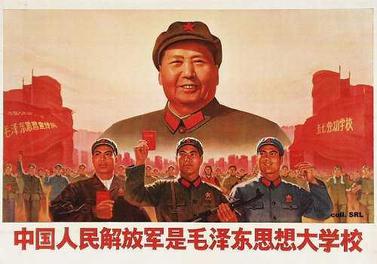
The Chinese Cultural Revolution had a massive impact on China between 1965 to 1968, the name of the Revolution is the name given to Mao's attempt to reassert his beliefs in China. Mao has been less than a dynamic leader from the late 1950s on, and feared others in the party might be taking on a leading role that weakened his power within the party and the country. Overall, the trigger of the Cultural Revolution was Mao's attemption to reimpose his authority on the party and therefore the country (Wikipedia). In September, 1965, a speech by Lin Piao urged pupils in schools and colleges to return to the basic principles of the revolutionary movement. Also, it encouraged for Chinese youths to criticize the liberals in the Chinese Communist Party and those apparently influenced by Nikita Khruschev of the USSR. Among many beliefs of Mao, Mao believed strongly that the progress China had made since 1949 had lead to a privileged class developing - engineers, scientists, factory managers and more. Mao also believed that there people were acquiring too much power at his expense (Learning about History).

Link to Image

Saturday, November 8, 2014

Risk Taking Researcher - Felipe M.

week 5#
Job: Risk Taking Researcher
Red Scarf Girl
Ji-Li Jiang

       I made a deep research about Chairman Mao's life this week. He was born in December 26, 1893 in Shaoshan village, his father, Mao Yichang became a wealthiest farmer in Shaoshan. Yichang's wife Wen Qimei was a Buddhist. Mao also became a Buddhist but abandoned his faith in his early teenage years. When Mao was 8 years old, he was sent to Shaoshan Primary School. When Mao was 13, he finished primary school and his father married him to a 17 year old girl. When Mao grew older, he became interested by the military prowess and nationalistic fervor of George Washington and Napoleon Bonaparte. In 1911, Mao began Middle School in Changsha. Revolutionary sentiment was strong in the city,  with widespread disagreement towards Emperor Puyi's absolute monarchy. Mao enrolled and dropped out of a police academy, a soap-production school, a law school, an economics school, and the government-run Changsha Middle School. In his first school year, Mao befriended an older student, Xiao Yu; together they went on a walking tour of Hunan, begging and writing literary couplets to obtain food.  A popular student, in 1915 Mao was elected secretary of the Students Society. Making an Association for Student Self-Government, he led protests against school rules.  Mao graduated in June 1919.
       Mao moved to Beijing, where his mentor Yang Changji had taken a job at Peking UniversityAt the university, Mao was made fun of due to his rural accent and lowly position. On May 4, 1919, students in Beijing gathered at the Gate of Heavenly Peace to protest the Chinese government's weak resistance to Japanese expansion in China. In Changsha, Mao had begun teaching history at the Xiuye Primary School.

Sunday, October 26, 2014

Chairman Mao, Guilhermo Pagnano Gonzalez

While reading the Red Scarf Girl by Ji Li Jang I have had a very disturbing question about a character depicted in the book as Chairman Mao. While reading and investigating the story I have learned and read some very ineteresting meager exoctic stories about the whatsoever prestigious leader; for instance, "Chairman Mao, had risked his life to go to mines of Anyuan by himself to establish a revolutionary base there." (pg.101) After having read this, and many other stories about the adaoucios Chairman Mao I decided to in a quest of examination about Chairman Mao's history background and life.


Born on December 26, 1893, in Shaoshan, Hunan Province, China, Mao Tse-tung served as chairman of the People's Republic of China from 1949 to 1959, and led the Chinese Communist Party from 1935 until his death. Mao's "Great Leap Forward" and the Cultural Revolution were outrageous and had disastrous consequences, but many of his goals, including stressing China's self-reliance, were generally admirable.


Mao was born into a peasant family in central China. After training as a teacher, he travelled to Beijing where he worked in the University Library. It was during this time that he began to read Marxist literature. In 1921, he became a founder member of the Chinese Communist Party (CCP) and set up a subsidiary in Hunan. In 1923, the Kuomintang (KMT) nationalist party had allied with the Chinese Communists to defeat the warlords who controlled much of northern China. Then in 1927, the KMT leader Chiang Kai-shek launched an anti-communist purge. Mao and his allies retreated after being surrounded by the KMT's to southeast China, where he eventually regrouped with many participants and followers to establish a new base. With so many disciples he made himself back to the north to establish roots and power


In 1958, in an attempt to create a more 'Chinese' form of communism, Mao launched the 'Great Leap Forward'. This was directed at mass mobilisation of labour to improve agricultural and industrial production. The result, instead, was a massive decline in agricultural output, which, together with poor harvests, led to famine and the deaths of millions. The policy was left aside and Mao's position weakened.

In an attempt to re ensure and prove his authority, Mao launched the 'Cultural Revolution' in 1966, aiming to suppress the country of 'impure' elements and revive the revolutionary spirit. As we have read, there was in intellectual attack of the four olds, old heritage, culture ,etc . One-and-a-half million people died and much of the country's cultural heritage was destroyed.


Chairman Mao with his believers and followers making themselves back to the north of china to reconquer the land KMT toke from them.


Chairman Mao poster that shows his power and act of force in the society.


Risk Taking Researcher Juho Kim- Rotation 3

The book Red Scarf Girl takes place in one of the most important times in Chinese history, the Great Proletarian Cultural Revolution, also known as the Chinese Cultural Revolution. The Cultural Revolution was a social political movement that took place in People's Republic of China from 1966- 1976. The Revolution was launched in May 1966 (Mao Zedong). Mao officially declared the Cultural Revolution to have ended in 1969, but its active phase lasted until the death of the military leader Lin Biao in 1971. After Mao's death and the arrest of the Gang of Four in 1976, reformers led by Deng Xiaoping gradually began to dismantle the Maoist policies associated with the Cultural Revolution (After Mao's Death).


On August 8, 1966, the party's Central Committee passed its "Decision Concerning the Great Proletarian Cultural Revolution", later to be known as the "Sixteen Points." This decision defined the Cultural Revolution as "a great revolution that touches people to their very souls and constitutes a new stage in the development of the socialist revolution in our country, a deeper and more deep stage."Adding on, at August 18, 1966, over a million Red Guards from all over the country gathered in and around Tiananmen Square in Beijing for a personal audience with the Chairman, Mao. Because he had ordered them to do so, as well as they obeyed him.

Tuesday, September 23, 2014

Risk Taking Researcher - Tobin Min

Red Scarf Girl
Ji-li Jiang
Risk Taking Researcher
Chapter 13-15

The Red Scarf Girl is a novel based on the cultural revolution. The key person that is always mentioned in the book is "Chairman Mao" or "Mao Zedong." So the things that I am going to research about are those two things.

The Chinese Cultural Revolution was a political-movement that took place in China from 1966 to 1976. The idea was set by Mao Zedong, the Chairman of the Communist Party of China and that time period. There were two main things that he wanted to achieve from this movement which are: Imposing Maoists in the party, and to enforce communism by removing capitalists, traditional and cultural elements of China. The movement was not a success, and impacted the country's politically, economically, and socially. In 1966, Mao insisted that the revisionists had to be removed because they were supposedly trying to restore capitalism. So to do this, youths formed Red Guard groups, and many senior officers were killed. And in the same time, Mao's personality Cult grew bigger. Many people suffered abuses including public humiliation, arbitrary imprisonment, torture, sustained harassment, and seizure of property. After the death of the military leader, Lin Biao, the active phase ended. However, the real endpoint was when the Gang of Four got arrested, and reformers led by Deng Xiaoping ended the Maoist reforms.


The most important person in this movement was Mao Zedong, the former Chairman of the Communist Party. He was a Chinese Communist and the founder of the People's Republic of China. He is from a wealthy family in Hunan. Mao adopted a Chinese Nationalists outlook in early life because of the many events that took place at that time. In 1949, he found PRC, which was controlled by the communist party. In 1966, he launched the Cultural Revolution. He is considered as both a great leader, and a dictator. Mao died on 9 September 1976.


Citations: 

BBC. "Mao Zedong." BBC News. BBC, 2014. Web. 23 Sept. 2014.

"Mao Tse-tung." Bio. A&E Television Networks, 2014. Web. 24 Sep. 2014.

History. "Cultural Revolution." History.com. A&E Television Networks, 2014. Web. 23 Sept. 2014.

"The Cultural Revolution". HistoryLearningSite.co.uk. 2005. Web.